
The Serengeti does not offer wildlife in the way that a zoo or a reserve offers wildlife — curated, contained, and predictable. It offers wildlife as it has always been: sovereign, unpredictable, and operating according to ecological laws that preceded human existence by millions of years. That is the difference between watching and witnessing.
Introduction
Every great wildlife destination has its signature species — the animal that defines the experience and draws travellers from across the world. The Serengeti has dozens. Lions that hunt in coordinated prides across open plains. Leopards that haul kill three times their body weight into the branches of riverside acacias. Cheetahs that accelerate from rest to 110 kilometres per hour across the short grass in pursuit of Thomson’s gazelle. Elephants that move through the woodland zones in matriarchal family groups following pathways worn into the earth over centuries. Wild dogs that hunt in coordinated relay packs with a success rate that shames every other African predator.
And behind all of these — supporting, competing with, and sustaining them — an ecosystem of such biological complexity and ecological integrity that the scientific community has been studying it continuously since the 1950s and still finds new layers of interaction, dependency, and wonder in its seemingly familiar landscapes.
A Serengeti wildlife safari tour is the most direct and comprehensive way to access this extraordinary ecosystem. It is a structured, guided journey through one of the world’s greatest concentrations of large mammals and birds, conducted by expert naturalists in purpose-built safari vehicles, and designed to deliver the deepest possible engagement with the Serengeti’s wildlife in the time available.
This guide explores the full breadth of what a Serengeti wildlife safari tour offers — from the flagship predators and mega-fauna that define the park’s global reputation to the supporting cast of birds, reptiles, smaller mammals, and invertebrates that together compose one of the most biodiverse terrestrial ecosystems remaining on Earth.
The Serengeti’s Wildlife: A Complete Portrait
The Predator Guild
The Serengeti’s predator community is without parallel in Africa. No other ecosystem concentrates so many large carnivore species in such numbers and offers such consistent, high-quality opportunities for observing predator behaviour in its full ecological context.
Lions are the Serengeti’s most iconic predator and its most consistently encountered large carnivore. The park supports approximately 3,000 individuals — roughly 40 distinct prides — occupying territories distributed across the full extent of the ecosystem. Serengeti lions are exceptionally well-habituated to safari vehicles, allowing for extended observation at close range that reveals the extraordinary complexity of pride social dynamics: the hierarchy of females, the competition between male coalitions, the developmental stages of cubs from helpless infants to sub-adults testing the boundaries of the pride’s tolerance.
Lion hunting behaviour in the Serengeti is best observed at dawn and dusk, when the combination of cooler temperatures and lower light encourages active hunting. Coordinated hunts — several females working together to isolate and bring down wildebeest or zebra that may weigh three times their individual body mass — are among the most athletically and strategically impressive wildlife events observable on a standard game drive.
Leopards are the Serengeti’s most enigmatic predators — solitary, secretive, and magnificently adapted to a life conducted largely in the vertical dimension of the acacia woodland. The Seronera River drainage is Tanzania’s premier leopard habitat, where well-habituated individuals are regularly observed resting in the forks of sausage trees and yellow-barked acacias during the heat of the day, descending at dusk to hunt and drink. Serengeti leopards frequently hoist kills — impala, Thomson’s gazelle, and occasionally young warthog — into trees beyond the reach of scavenging hyenas, and a leopard with a hoisted kill in a riverside acacia, photographed against the Serengeti sky, is one of the most sought-after wildlife images in East Africa.
Cheetahs occupy the Serengeti’s open grassland habitat with a grace and athleticism that makes every encounter extraordinary. The park supports a population of approximately 500 individuals — one of Africa’s largest — and the flat, unobstructed terrain of the plains makes cheetah behaviour highly visible from safari vehicles. The full hunting sequence — the stalk, the sprint, the trip, the suffocating throat bite — can unfold within fifty metres of a positioned vehicle, creating a wildlife viewing experience of visceral, breathless intensity.
Spotted hyenas are the Serengeti’s most numerous large predator, present in clan groupings across the entire ecosystem. Far more ecologically important than their scavenging reputation suggests, spotted hyenas are accomplished hunters whose kills are frequently stolen by lion prides rather than the reverse. The complex social dynamics of hyena clans — matriarchal, hierarchical, and communicatively sophisticated — reward patient, sustained observation by naturalist guides who understand their behaviour.
African wild dogs are the Serengeti’s rarest and most endangered large carnivore, present in small populations that range widely across the ecosystem’s less-visited zones. A wild dog sighting is among the most coveted wildlife encounters in the Serengeti — these painted predators are extraordinarily social, cooperatively devoted parents, and hunters of remarkable efficiency and endurance whose prey success rate of approximately 80% far exceeds the lion’s typical 30%.
The Mega-Herbivores
Elephants move through the Serengeti’s woodland zones in family groups led by experienced matriarchs whose ecological memory spans decades — the location of water sources, the seasonal availability of food plants, the traditional pathways that connect the Serengeti’s habitats across generations. Serengeti elephants are generally well-habituated to safari vehicles, and close encounters with family groups — especially when calves are present — reveal the extraordinary emotional and social complexity of elephant family life.
Hippopotamus congregations in the Grumeti and Mara Rivers provide some of the Serengeti’s most reliable and dramatic wildlife viewing outside the game drive context. A hippo pool at mid-morning — the animals pressed together in the shallows, vocalising with extraordinary force, occasionally erupting in territorial disputes of impressive violence — is a spectacle that rewards extended observation and rewards it differently at different times of day.
Giraffes — the world’s tallest living animals — are distributed across the Serengeti’s woodland and savannah zones and provide one of the ecosystem’s most visually distinctive wildlife experiences. A giraffe galloping across the Serengeti in full stride, or a group of males engaging in the slow-motion combat of necking, or a tower of giraffes silhouetted against the kopjes at sunset — these are among the images that make the Serengeti one of the world’s most photographed wildlife destinations.
Cape buffalo herds of several hundred to several thousand individuals move through the Serengeti’s grassland and woodland zones year-round, their massive aggregations providing the spectacle of large-herbivore abundance that has defined the Serengeti landscape for millions of years. Old buffalo bulls — “dagga boys” — separated from the herd and living in small bachelor groups near permanent water are among the most dangerous and most characterful wildlife encounters available on a Serengeti game drive.
The Supporting Cast — Plains Game and Antelope
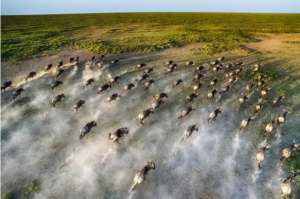
The Serengeti’s plains antelope community represents one of the most biodiverse large herbivore assemblages in Africa. Thomson’s gazelle — delicate, swift, and present in enormous numbers on the short grass plains — are the primary prey species of cheetahs and wild dogs. Grant’s gazelle, larger and more heat-tolerant, range further from water and occupy the dryer zones of the ecosystem. Topi — the russet-coloured antelope that stand sentinel on termite mounds scanning their territories — are a distinctive Serengeti presence. Kongoni (Coke’s hartebeest), eland (Africa’s largest antelope), impala, warthog, zebra, and dik-dik complete an antelope portfolio of extraordinary diversity and abundance.
The Reptile and Smaller Mammal Community
A complete Serengeti wildlife safari tour extends well beyond the mega-fauna to encompass the full ecological complexity of the ecosystem. Nile monitors — Africa’s largest lizard — stalk the riverine zones with prehistoric dignity. Rock pythons of impressive size inhabit the kopje country. Nile crocodiles in the Grumeti and Mara Rivers are among the largest individuals of the species remaining in East Africa. Dwarf mongooses at termite mounds, banded mongooses in family troops, bat-eared foxes on the open plains, servals hunting rodents in the long grass at dawn — the smaller mammals of the Serengeti are as ecologically fascinating as their larger neighbours and reward the attentive observer with encounters of surprising intimacy.
The Birds — A World-Class Destination
With over 500 recorded bird species, the Serengeti is one of Africa’s premier birding destinations and a genuinely world-class wildlife experience in its own right. Raptors dominate the open savannah: martial eagles, bateleurs, tawny eagles, Verreaux’s eagle-owls, secretary birds stalking through the grass on their extraordinary long legs, and the seasonal influx of Eurasian migrants between November and April that can concentrate dozens of species at productive wetland sites.
The kori bustard — the world’s heaviest flying bird — walks the open plains with the unhurried authority of an animal that has nothing to fear. Ostriches stride through the grassland in small groups, their extraordinary evolutionary divergence from flight providing a constant reminder of the diversity of adaptive solutions available to a group as versatile as birds. Lilac-breasted rollers, superb starlings, grey-crowned cranes, and the extraordinary diversity of sunbirds, weavers, and cisticolas in the riverine vegetation complete a bird list that rewards dedicated ornithological attention at every taxonomic level.
Structuring a Serengeti Wildlife Safari Tour
Zone Selection and Timing
A Serengeti wildlife safari tour delivers different wildlife experiences in different zones and at different times of year, and effective tour planning begins with understanding this spatial and temporal variation.
The central Seronera zone is the backbone of any year-round Serengeti wildlife tour — the most productive general wildlife area in the park, accessible in all seasons, and home to the densest leopard population, the most stable lion prides, the best cheetah open-plain habitat, and the infrastructure to support a range of tour formats from budget camping to ultra-luxury. A minimum of two nights in Seronera is recommended for any Serengeti wildlife tour, regardless of season.
The southern plains and Ndutu zone (December to March) specialises in the calving season wildlife concentration — the highest predator density of the year, extraordinary cheetah and wild dog hunting frequency, and the biological intensity of half a million wildebeest calves on the short grass plains. Wildlife tour itineraries in this period should allocate at least three dedicated days on the southern plains.
The northern Serengeti (July to October) combines the Migration crossing drama with excellent year-round wildlife in the Kogakuria kopje country — leopards, lions, and a full plains game community that is largely undisturbed by visitor pressure in this remote zone. Wildlife tours to the north are best conducted with a minimum of three nights to justify the domestic flight required for access.
Game Drive Timing and Technique
The quality of a Serengeti wildlife safari tour is profoundly shaped by the timing and technique of game drives. The golden hours — the two hours after dawn and the two hours before dusk — are when wildlife is most active and most visible, the light is most photogenic, and the atmospheric quality of the Serengeti is at its most evocative. Any tour itinerary that prioritises mid-day game drives at the expense of these golden windows sacrifices significant wildlife encounter quality.
Equally important is the guide’s technique of active searching versus passive observation. The finest Serengeti guides combine continuous visual scanning with detailed knowledge of individual animal territories, seasonal movement patterns, and the behavioural cues — a vulture descending, an impala staring fixedly into a thicket, the particular alertness of a zebra herd — that indicate predator activity in the vicinity. Learning to read these cues alongside your guide transforms every game drive from a linear journey between sightings into a continuous detective story.
Photography on a Wildlife Tour
The Serengeti’s combination of open terrain, habituated wildlife, and extraordinary light creates ideal conditions for wildlife photography at every skill level. A wildlife safari tour that incorporates even basic photographic guidance — from your naturalist guide or from specialist photography guides available at some luxury camps — significantly enhances the creative value of the experience.
Key photography considerations include: telephoto capacity (a 300-400mm lens is the minimum useful focal length for most wildlife subjects at standard game drive distances); vehicle positioning (guide cooperation with camera requirements — low angles, clean backgrounds, optimal light direction — is standard at luxury level); and patience at productive sightings rather than the impulse to move on after the first shot is taken.
Key Takeaways
- The Serengeti supports one of the world’s most diverse and abundant large mammal communities — with approximately 3,000 lions, 500 cheetahs, significant populations of all other major African predators, and mega-herbivore assemblages of extraordinary scale, the park delivers consistent, high-quality wildlife across every zone and season.
- The predator guild is the Serengeti’s defining wildlife feature — the concentration and habituation of lion, leopard, cheetah, spotted hyena, and wild dog in a single ecosystem creates predator observation opportunities unmatched anywhere in Africa.
- Zone selection and timing are the most important planning variables for wildlife tour quality — the central Seronera zone delivers year-round predator excellence; the southern plains specialise in the calving season wildlife concentration; the northern zone offers Migration drama combined with remote wilderness wildlife.
- Dawn and dusk game drives are essential for the highest wildlife encounter quality — the golden hours concentrate active predator behaviour, optimal photographic light, and the atmospheric dimension of the Serengeti that mid-day game drives cannot replicate.
- Birds are a world-class wildlife tour feature in their own right — with over 500 species including extraordinary raptor diversity, seasonal migrant influxes, and some of Africa’s most visually spectacular species, the Serengeti rewards ornithological attention at every level of expertise.
- Smaller mammals, reptiles, and invertebrates add ecological depth to any Serengeti wildlife tour — a guide who incorporates these components alongside the mega-fauna delivers a significantly richer and more complete understanding of the ecosystem’s biological complexity.
- Private vehicles with expert resident naturalists deliver categorically superior wildlife tour quality compared to shared vehicle arrangements — undivided guide attention, flexible pacing, and the ability to remain with productive sightings indefinitely are transformative advantages.
Questions & Answers
Q: What wildlife can I realistically expect to see on a Serengeti wildlife safari tour? A: On a well-planned, guide-led Serengeti wildlife safari tour of five days or more in the central zone, the following species can be expected with high confidence: lion (near-certainty on any multi-day tour), elephant, giraffe, zebra, Cape buffalo, hippopotamus (at river or pool locations), topi, impala, Thomson’s and Grant’s gazelle, warthog, olive baboon, vervet monkey, ostrich, and a wide variety of raptors and other birds. Leopard sightings in the Seronera area are reliable with an experienced guide — expect a good probability over five days. Cheetah sightings on the open plains are common. Wild dog encounters require luck and a guide with current field intelligence. Black rhinoceros are present in very small numbers in the southern Serengeti and are rarely encountered. The Migration adds wildebeest, zebra, and gazelle in numbers that transform the landscape entirely during the relevant seasonal phases.
Q: How does the Serengeti compare to other African wildlife destinations for a wildlife safari tour? A: The Serengeti ranks alongside South Africa’s Greater Kruger ecosystem and Botswana’s Okavango Delta as one of the world’s top three wildlife safari destinations, and it holds specific advantages over both. Its predator density and diversity — particularly the concentration of all five large felid/canid predators in a single accessible ecosystem — exceeds both Kruger and Okavango in overall predator wildlife quality. Its scale — 14,763 square kilometres of core park, plus extensive adjoining protected areas — creates a sense of wilderness and ecological completeness that smaller, more managed reserves cannot replicate. The Great Migration is a Serengeti-exclusive experience (shared only with the Masai Mara) that no other wildlife destination offers. The trade-off compared to Kruger is self-drive accessibility; compared to Okavango, it is the absence of boat and mokoro (dugout canoe) wildlife activity. For a dedicated wildlife safari tour, the Serengeti’s combination of scale, predator quality, and ecological integrity places it at the summit of the global wildlife destination hierarchy.
Q: Is a Serengeti wildlife safari tour appropriate for someone with no prior safari experience? A: The Serengeti is not only appropriate for first-time safari travellers — for many wildlife professionals and experienced travel writers, it remains the single best introduction to African wildlife that the continent offers. The quality of the wildlife, the professionalism of the guide community, the range of accommodation and tour formats available at every budget and experience level, and the sheer abundance and visibility of the animals create an environment in which first-time visitors consistently exceed their own wildlife encounter expectations. The learning curve is steep and deeply enjoyable: by day three of a well-guided wildlife tour, most first-time visitors are identifying species confidently, reading animal behaviour instinctively, and beginning to understand the ecological relationships that make the Serengeti function as a coherent living system.
Q: What is the best vehicle setup for a Serengeti wildlife safari tour? A: The gold standard for Serengeti wildlife safari tour vehicles is the Toyota Land Cruiser 78-series pop-top, a high-clearance, four-wheel-drive vehicle with a roof that opens fully for 360-degree viewing and photography. The elevated seating position provides clear sightlines above the savannah grass, the vehicle’s reputation for mechanical reliability in remote off-road conditions is unmatched in the safari industry, and the pop-top configuration allows standing photography with a stable vehicle platform. For serious wildlife photographers, some operators offer modified Land Cruisers with roof hatches, beanbag mounts, and lowered floor sections that allow ground-level photography angles. Vehicle age matters: newer vehicles (less than five years old) are significantly more reliable and comfortable on long game drive days than older models, and a breakdown in a remote corner of the Serengeti on a productive morning is a significant quality-of-experience event. Always ask operators about vehicle age and model before booking.
Q: How important is guide knowledge for the quality of a Serengeti wildlife tour? A: Guide knowledge is not simply important — it is the single variable that most determines the quality of a Serengeti wildlife safari tour. The difference between an average guide and an exceptional one is not measured in the number of species encountered (both will find lions and elephants) but in the depth of understanding those encounters generate. An exceptional Serengeti guide knows the names and territories of individual lion pride members, can identify a specific leopard by its rosette pattern and predict its afternoon movements based on morning tracking, understands the ecological significance of every species interaction observed and explains it as part of a coherent narrative, and maintains a current field intelligence network that positions the vehicle at productive locations before other guides are aware of the opportunity. This knowledge is accumulated over years and decades of dedicated field presence and cannot be replicated by any combination of reference books, digital databases, or brief training programmes. When evaluating Serengeti wildlife tour operators, request specific information about individual guide credentials, years of Serengeti experience, and areas of specialist knowledge. The answer to this question tells you more about the likely quality of your wildlife tour than any other single piece of information.
Conclusion
A Serengeti wildlife safari tour is, at its most honest, an act of humility. It places a human being — accustomed to environments shaped entirely by human preference, operating on human timescales, populated by human concerns — into a landscape where none of those conditions apply. The Serengeti is not shaped by human preference. It operates on geological, evolutionary, and ecological timescales that render the span of a human lifetime insignificant. Its concerns are entirely its own.
And yet, paradoxically, it is one of the most humanly resonant environments on Earth. Because the wildlife it shelters — the predators, the prey, the scavengers, the birds, the insects, the grass itself — constitutes the ecological context in which our species evolved. The Serengeti is not foreign to us. At some deep biological level, we recognise it. The vigilance that lions inspire, the awe that elephants produce, the sheer arrested attention that a hunting cheetah commands — these responses are not learned. They are inherited. We are responding to the Serengeti with nervous systems that were shaped, in part, by exactly this landscape.
A great wildlife safari tour returns you to this recognition — not through sentimentality or mysticism, but through the simple, direct, repeated encounter with extraordinary wild animals in their full ecological context. After five days of genuinely expert-guided wildlife observation in the Serengeti, you understand, in the most concrete and experiential way, why this landscape matters. Why the lions must be protected. Why do elephants need their corridors? Why the wild dogs — barely a thousand individuals remaining across their former range — are worth every conservation dollar committed to their survival.

