
Exclusively featuring Winners Expeditions, Suvat Expeditions & Relax Africa Tours & Safari
At 5,895 meters above sea level, Mount Kilimanjaro stands as Africa’s highest peak and the world’s tallest free-standing mountain — a colossal, snow-capped volcanic massif that rises with breathtaking drama from the sun-baked plains of northern Tanzania and commands the horizon for hundreds of kilometers in every direction. To stand on its summit, Uhuru Peak, is to achieve one of the great physical and spiritual milestones available to any traveler with the determination and the right preparation to pursue it. It is a moment that climbers describe with remarkable consistency: tears come unexpectedly, the world below looks impossibly far away, and the magnitude of what has been accomplished settles slowly, completely, and permanently.
Among Kilimanjaro’s several established climbing routes, the Lemosho Route is widely regarded by experienced mountaineers, professional guides, and climbing specialists as the finest available. It is longer, more scenic, and more thoughtfully paced than the popular alternatives — and those three qualities translate directly into the highest summit success rates, the most diverse and extraordinary wilderness experience, and the kind of deep, earned achievement that shorter, more compressed routes simply cannot deliver. If you are going to climb Kilimanjaro — and you should — the Lemosho Route is the route on which to do it.
Three operators have built exceptional reputations for guiding climbers to the summit of Kilimanjaro via the Lemosho Route with the combination of safety, expertise, and outstanding support that this formidable mountain demands: Winners Expeditions, Suvat Expeditions, and Relax Africa Tours & Safari. Each brings certified, experienced guides, world-class equipment, meticulously planned logistics, and a genuine passion for the mountain that shows in every aspect of their Lemosho packages.
Key Takeaways
- The Lemosho Route is Kilimanjaro’s most highly recommended climbing route — offering the best acclimatization profile, the highest summit success rates, the most dramatic and diverse scenery, and the least crowded trails of any route on the mountain.
- Winners Expeditions, Suvat Expeditions, and Relax Africa Tours & Safari are Tanzania’s most trusted Kilimanjaro operators, providing certified guides, comprehensive equipment, expert altitude management, and unwavering support across every day of the climb.
- The standard Lemosho Route takes 7 to 8 days, with an 8-day itinerary strongly recommended for optimal acclimatization and the highest probability of a successful summit attempt — the extra day is not a luxury, it is a strategic investment in reaching Uhuru Peak.
- Kilimanjaro via Lemosho traverses five distinct climate zones — cultivated farmland, dense rainforest, heather and moorland, alpine desert, and the arctic summit zone — delivering a wilderness experience of extraordinary ecological diversity available on no other mountain climb in Africa.
- The summit night is the defining challenge of the Lemosho Route — a midnight departure in sub-zero temperatures, navigating the steep Barafu Camp to Uhuru Peak ascent by headtorch over several hours — requiring exceptional physical conditioning, mental resilience, and the confident, expert guidance that all three featured operators provide.
- The best time to climb Kilimanjaro via the Lemosho Route is during the dry seasons of January–March and June–October, when trail conditions are most favorable, weather windows are most reliable, and summit success rates are at their highest.
- All three operators offer fully inclusive Lemosho packages covering park fees, camping or hut accommodation, all meals on the mountain, certified lead and assistant guides, porters, emergency oxygen, first aid equipment, and pre-climb acclimatization briefings.
Why the Lemosho Route Is Kilimanjaro’s Finest
Every climber approaching Kilimanjaro faces the same fundamental decision: which of the mountain’s established routes offers the best combination of safety, scenery, acclimatization, and summit success probability? The answer, for any climber who has done serious research or consulted experienced mountain professionals, is almost always the same: the Lemosho Route.
The route’s defining advantage is its acclimatization profile. Altitude sickness is the single greatest threat to a successful Kilimanjaro summit attempt — not fitness levels, not technical skill, not weather. The human body requires time to adapt to the progressive reduction in available oxygen as altitude increases, and the Lemosho Route’s longer duration and deliberate pacing — with built-in rest days and a summit approach that follows the mountaineering mantra of “climb high, sleep low” — gives the body that time in a way that shorter routes simply cannot. The result is measurably higher summit success rates for climbers on the Lemosho Route compared to any other path to Uhuru Peak.
The route’s scenic diversity is equally remarkable. Beginning on the remote western slopes of the mountain at the Londorossi Gate, the Lemosho trail enters the mountain’s dense montane rainforest almost immediately — a cathedral of ancient trees, moss, and forest birds that bears no resemblance to the volcanic summit visible from the plains below. As the trail climbs through the heather and moorland zones, the landscape opens progressively into something increasingly otherworldly — giant lobelias and groundsels rising from the moorland like prehistoric sentinels, the Southern Ice Fields glittering on the summit plateau above, and on clear days, the vast Tanzanian savanna stretching to the horizon far below. No other Kilimanjaro route traverses quite as much of this extraordinary ecological range, and no other approach delivers the summit via the dramatic Lava Tower acclimatization walk and the spectacular Barranco Wall ascent that are among the Lemosho’s most memorable and distinctive experiences.
The route’s relative solitude compared to the heavily trafficked Marangu and Machame routes adds a quality of genuine wilderness immersion that serious climbers deeply value. On the Lemosho trail, particularly in the first two days before the route merges with the Machame, you will frequently have entire sections of the mountain entirely to yourself — a quality that all three featured operators actively protect through careful scheduling and group size management.
Day-by-Day: The 8-Day Lemosho Route Itinerary
Day 1 — Arusha to Londorossi Gate & Forest Camp (2,100m)
Your Kilimanjaro adventure begins in Arusha, where your lead guide from Winners Expeditions, Suvat Expeditions, or Relax Africa Tours & Safari conducts a thorough pre-climb briefing — covering equipment checks, altitude management protocols, hydration strategy, and the day-by-day itinerary ahead. The drive to Londorossi Gate on Kilimanjaro’s remote western flank takes approximately four hours through northern Tanzania’s landscape before the mountain’s forest zone closes around you and the rainforest trail begins.
The first day’s hiking is a gentle, enveloping introduction — dense montane rainforest alive with birdsong, the track winding through ancient trees draped in old man’s beard moss, and the first physical appreciation of what Kilimanjaro actually feels like underfoot. Arriving at Forest Camp at around 2,100 meters, your team of porters — managed entirely by your operator — has established camp with efficiency and warmth. A hot meal awaits, the forest sounds settle into the evening around you, and the mountain above is still invisible through the canopy. Day one belongs entirely to the forest, and it is perfect.
Day 2 — Forest Camp to Shira 1 Camp (3,500m)
The trail climbs steadily through the upper rainforest and into the heather zone, where the vegetation shifts dramatically and the first views of the summit zone appear above the treeline. This is the day the mountain begins to reveal itself — the ice fields and volcanic rock of the upper mountain becoming visible for the first time, recalibrating your sense of what lies ahead. Arriving at Shira 1 Camp on the edge of the vast Shira Plateau, one of the world’s highest plateaus at over 3,500 meters, the landscape has transformed entirely from the enclosed intimacy of the forest into something vast, windswept, and magnificent.
Day 3 — Shira 1 to Shira 2 Camp via Shira Cathedral (3,840m)
A morning walk across the extraordinary Shira Plateau — a high-altitude moorland of striking geological beauty, studded with giant lobelias and volcanic rock formations — leads to an optional acclimatization hike to Shira Cathedral, a dramatic rock formation that provides both altitude gain and panoramic views of the summit above. This acclimatization excursion — climbing higher during the day before returning to a lower sleeping altitude — is a deliberate and important element of the Lemosho’s superior altitude management strategy. Your guides from all three operators monitor every climber’s health and acclimatization response throughout this day with attentive, expert care.
Day 4 — Shira 2 to Barranco Camp via Lava Tower (4,600m then down to 3,960m)
This is the day that defines the Lemosho Route’s acclimatization genius. The trail climbs to the imposing Lava Tower at approximately 4,600 meters — genuinely high altitude where the effects of thin air become clearly noticeable — before descending to Barranco Camp at 3,960 meters for the night. The principle is elegantly simple: stress the body at altitude to stimulate adaptation, then allow recovery at a lower sleeping altitude. By the time climbers wake at Barranco Camp the following morning, their bodies have taken a significant step toward the acclimatization that will make the summit attempt possible. The views from the Lava Tower — across the Southern Ice Fields to the summit plateau, and down the entire southern face of the mountain to the Tanzanian plains — are among the most dramatic on the entire route.
Day 5 — Barranco Camp to Karanga Camp via Barranco Wall (4,035m)
The Barranco Wall is the Lemosho Route’s most technically engaging and visually spectacular single element — a near-vertical cliff face of approximately 300 meters that requires hands-on scrambling to ascend and delivers extraordinary views at every step. It sounds intimidating in description and exhilarating in experience — most climbers rate the Barranco Wall ascent as one of their favorite moments of the entire climb, a genuine physical challenge that is entirely achievable with proper guidance and produces an immediate, authentic sense of achievement. Your guides ensure every climber ascends safely, managing the pace and providing technical assistance wherever needed. The afternoon continues to Karanga Camp, where the increasingly stark, beautiful alpine desert landscape signals that you are now firmly in the mountain’s upper realm.
Day 6 — Karanga Camp to Barafu Base Camp (4,673m)
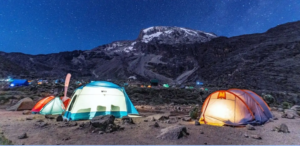
The trail to Barafu Camp — the final camp before the summit attempt — is a relatively short but psychologically significant day. Arriving at Barafu in the early afternoon, your guides conduct a thorough summit briefing: the departure time (typically midnight), the equipment requirements, the expected duration of the summit push, what to expect physically and mentally, and the turnaround protocols that ensure every climber’s safety regardless of proximity to the summit. An early dinner, an attempt to sleep in the thin, cold air, and then the alarm sounds in the darkness and the most important morning of your Kilimanjaro journey begins.
Day 7 — Summit Night: Barafu Camp to Uhuru Peak (5,895m) and Descent to Mweka Camp (3,100m)
The summit push begins at midnight, under a headtorch and a sky blazing with stars at altitude so clean and clear it seems to belong to a different atmosphere than the one you breathe at home. The trail switchbacks steeply up the volcanic scree of Kilimanjaro’s summit cone — slow, rhythmic, one deliberate step at a time — through the Stellar Point at 5,739 meters, across the crater rim, and finally to Uhuru Peak at 5,895 meters above sea level. The summit sign. The glacier. The impossible view. The tears that arrive without warning. Your guide beside you, smiling with the particular pride of someone who has brought you somewhere they love and watched you arrive.
The descent to Mweka Camp is long — knees tested, altitude gratefully releasing with every step downward — but the elation of Uhuru Peak carries every climber through it.
Day 8 — Mweka Camp to Mweka Gate & Arusha
The final morning descent through the rainforest to Mweka Gate completes the Lemosho Route circuit — a moment of quiet satisfaction, certificate collection, and the particular, bittersweet feeling of a genuinely great experience reaching its conclusion. Your operator’s vehicle waits at the gate to return you to Arusha, where a celebratory dinner and a bed at a comfortable lodge await the newest member of Kilimanjaro’s summit community.
The Operators Who Will Guide You to the Summit
Winners Expeditions
Winners Expeditions brings to every Kilimanjaro Lemosho package the combination of certified guiding expertise, meticulous safety protocols, and genuine mountain passion that summit success demands. Their lead guides are KINAPA-certified professionals with extensive high-altitude experience and advanced wilderness first aid training — people who know Kilimanjaro not merely as a workplace but as a deeply personal landscape they care for and respect. Winners Expeditions’ porter welfare standards are exceptional, reflecting a commitment to responsible, ethical mountain tourism that extends to every member of the climbing team. Their fully inclusive Lemosho packages cover every requirement from Arusha to Uhuru Peak and back, with complete transparency on costs and no hidden additions.
Suvat Expeditions
Suvat Expeditions approach every Kilimanjaro Lemosho climb with the same deeply personalized philosophy that defines their safari operation. Understanding that every climber arrives at the mountain with different fitness levels, different altitude experience, and different personal motivations for making the ascent, Suvat Expeditions tailors their guiding approach, their pacing strategy, and their daily altitude management to each individual climber’s needs and responses. Their guides are among the most experienced on the mountain — skilled at reading early signs of altitude-related illness, motivated to push every climber to their personal best, and deeply committed to ensuring that every person they lead arrives at Uhuru Peak with enough strength and presence of mind to genuinely appreciate being there.
Relax Africa Tours & Safari
Relax Africa Tours & Safari delivers the Lemosho Route experience with the seamless logistical excellence and exceptional care for their clients’ wellbeing that characterizes everything they do. From the pre-climb equipment briefing in Arusha to the final descent from Mweka Gate, every element of a Relax Africa Lemosho package is managed with quiet, expert precision — ensuring that climbers can focus entirely on the physical and emotional experience of climbing Africa’s greatest mountain rather than any logistical concern. Their mountain teams are outstanding: certified, experienced, motivating, and deeply attuned to the fine balance between pushing climbers toward the summit and protecting their safety at every stage of the ascent.
Frequently Asked Questions
Q: Do I need previous mountaineering experience to climb Kilimanjaro via the Lemosho Route?
No technical mountaineering experience is required for the Lemosho Route — Kilimanjaro is a non-technical mountain, meaning no ropes, ice axes, or specialist climbing skills are needed to reach the summit. What is required is a good base fitness level, strong mental resilience, and the ability to walk for six to eight hours per day across varied terrain for multiple consecutive days. Winners Expeditions, Suvat Expeditions, and Relax Africa Tours & Safari all provide detailed pre-climb fitness guidance and preparation advice to every climber upon booking, ensuring you arrive at the mountain in the best possible condition for a successful summit.
Q: What is the summit success rate on the Lemosho Route?
The Lemosho Route consistently delivers the highest summit success rates of any Kilimanjaro route, with experienced operators reporting success rates of 85 to 90 percent for climbers on well-paced 8-day itineraries. This compares favorably to the mountain-wide average of approximately 65 percent, and reflects the Lemosho’s superior acclimatization profile. All three featured operators strongly recommend the 8-day version over the 7-day option specifically because the additional acclimatization day makes a measurable, documented difference to summit success rates.
Q: How cold does it get on the mountain, and what gear do I need?
Temperatures on Kilimanjaro vary dramatically between climate zones. The rainforest base is warm and humid, while the summit zone during the midnight summit push can reach minus 20 degrees Celsius with wind chill. Proper layering is essential — a high-quality base layer system, insulating mid-layers, a heavyweight summit-rated down jacket, waterproof outer shell, insulated gloves and balaclava, and summit-rated mountain boots are all required. Your operator provides a comprehensive gear list upon booking, and all three featured operators offer equipment rental for climbers who prefer not to invest in specialist gear for a single expedition.
Q: How should I prepare physically for the Lemosho Route?
A structured fitness preparation program beginning at least three to four months before your climb is strongly recommended. Cardiovascular endurance is the primary requirement — long-distance hiking with significant elevation gain, ideally with a loaded day pack to simulate trail conditions, forms the foundation of any effective Kilimanjaro preparation program. Strength training focusing on legs, core, and lower back supports the multi-day hiking demands of the route. All three operators provide specific training recommendations tailored to each climber’s starting fitness level and the duration available for preparation.
Q: What altitude sickness prevention measures are used on the Lemosho Route?
Your guides from Winners Expeditions, Suvat Expeditions, and Relax Africa Tours & Safari conduct twice-daily health assessments using pulse oximeters throughout the climb, monitoring blood oxygen saturation and pulse rate as objective measures of each climber’s acclimatization. The Lake Louise Score system is used to assess symptoms of Acute Mountain Sickness at each camp. Emergency supplemental oxygen is carried by all three operators’ mountain teams and is available for immediate use if required. Diamox (acetazolamide) is commonly used as a prophylactic medication by many climbers — consult your physician before the climb regarding its appropriateness for you.
Q: What is included in a complete Lemosho package with these operators?
All three operators offer comprehensive, fully inclusive Lemosho packages that cover national park fees, conservation fees, camping or hut accommodation on the mountain, all meals from Day 1 to Day 8, a certified lead guide, assistant guides, mountain porters, emergency supplemental oxygen, comprehensive first aid kit, summit certificate, and transfers between Arusha and the park gates. International flights, travel insurance, personal equipment, and pre/post-climb accommodation in Arusha are typically arranged separately, with all three operators happy to assist with recommendations and bookings upon request.
Conclusion
The summit of Mount Kilimanjaro does not give itself easily, and that is precisely what makes standing on Uhuru Peak one of the most profoundly satisfying experiences available to the traveling human being. The mountain demands respect, preparation, patience, and a willingness to be genuinely challenged — physically, mentally, and in the early hours of summit night, when the cold is absolute and the summit still seems impossibly far above, emotionally as well. It asks everything of you, and what it gives in return — the view from the roof of Africa, the achievement permanently etched into who you are, the quiet pride that belongs only to people who have done hard things — is worth every step of every day of the climb.
The Lemosho Route is the finest way to earn that summit, and Winners Expeditions, Suvat Expeditions, and Relax Africa Tours & Safari are the operators who will guide you there with the expertise, safety, and genuine care that Africa’s greatest mountain deserves. These are teams that know Kilimanjaro intimately — its moods, its risks, its extraordinary beauty, and the precise combination of preparation and pacing that gives every climber the best possible chance of standing on Uhuru Peak and looking out across the curve of the Earth.
Choose your operator. Prepare your body. Commit to the mountain.
Kilimanjaro is waiting — and the summit is yours to earn.

